- Las Vegas, Nevada
- New Jersey
- New York
- Las Vegas, Nevada
- New Jersey
- New York

Tenex

What is Tenex?
Tenex is the brand name for percutaneous tenotomy, a minimally invasive procedure used in the management of chronic tendon conditions. Tendon injuries are common in athletics as well as among individuals involved in everyday activities and can be painful and functionally limiting. Tenex has been in use for over two decades and is recognized as a valuable option for certain chronic tendon issues, though it is not as widely known or utilized as some other treatment approaches.
Table of Contents
What types of tendon injuries can be treated with TENEX?
- Golfer’s elbow
- Tennis elbow
- Rotator cuff–related tendon conditions
- Runner’s knee
- Achilles tendinopathy
- Plantar fasciitis
Tenex is a minimally invasive procedure that may be used to support the management of chronic tendon conditions by addressing damaged tendon tissue and helping promote improved function when conservative treatments have not been successful.

Why are tendon injuries so hard to treat?
When a tendon becomes injured, small microtears can develop within the normal tendon structure. Tendons have a limited blood supply, which makes healing slower and less predictable. Over time, this may result in scar tissue formation. This abnormal tendon tissue can become weaker, less functional, and painful.
Ideally, treatment would involve stopping activity and allowing rest and time for the body to heal. However, many people are unable to do this for a variety of reasons, including:
- Lack of a proper diagnosis
- Not realizing the injury is significant
- Wanting to continue sports or physical activity
- Hoping the condition will resolve on its own
Some tendon injuries may improve on their own, but if symptoms persist for several months without improvement, treatment options can become limited. For many people with chronic tendon conditions, rest and physical therapy may not be sufficient, and surgery may be very difficult.
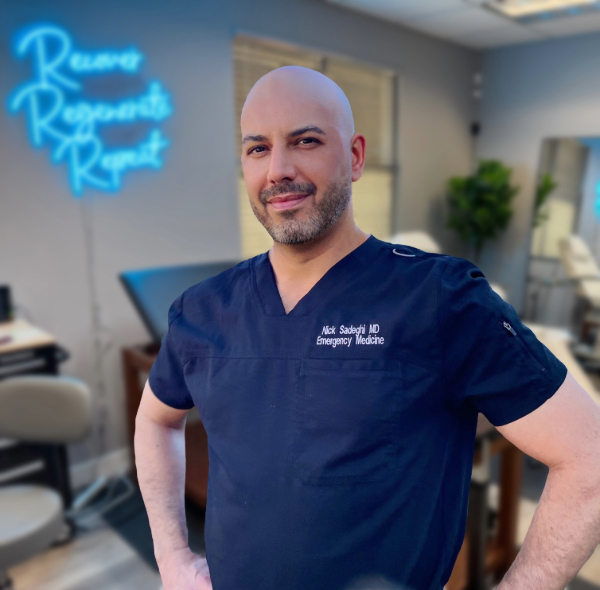
Meet Dr. Nick Sadeghi
“The mission of my regenerative clinic is to help you feel better, look better, and support longevity and vitality—so you can remain as active, healthy, and engaged as possible for as long as possible.”
If you’re over 35 and feeling tired, gaining weight, losing motivation, struggling in the gym, or noticing changes in your libido—you’re not crazy. You’re not weak. And you’re definitely not alone.
I felt it too.
Using advanced regenerative and longevity-focused medicine, my practice is designed to support recovery, performance, and healthy aging. Our core treatments focus on optimizing natural biological processes with therapies such as Hormone Replacement Therapy, NAD, Regenerative Biologic treatments, Platelet-Rich Plasma, Peptides, Tenex, EBOO, and other modern techniques.
Dr. Nick Sadeghi
How does Tenex work?
Tenex is a minimally invasive option used in the management of chronic tendon conditions. It involves a small, needle-like device that is inserted into the tendon while the physician uses ultrasound imaging to precisely guide the device to the targeted area.
Key features of the procedure:
- Minimally invasive
- Performed in the office under local anesthesia
- Incision is only a few millimeters in length
- Device tip vibrates at an ultrasonic frequency
- Designed to break up and remove scar tissue while preserving surrounding healthy tendon
Once damaged or scarred tendon tissue is removed, the body’s natural repair response can occur within the tendon.
It is important to note that the device does not cut the tendon. The treatment works through ultrasonic vibration. The system also uses continuous irrigation and suction to flush out and remove disrupted tissue debris.

How long does it take?
The procedure is performed in the office under local anesthetic and is generally well tolerated. There is some time required for setup and preparation, so patients can expect the entire visit to take less than 45 minutes. The actual procedure time is typically less than 3 minutes.
What is the recovery process?
Most patients experience minimal discomfort after the procedure, as there is no cutting or stitches. After the procedure, it is important to rest the treated area. Once abnormal scar tissue is removed, the body begins its natural repair process, so avoiding reinjury during this period is important to support recovery.
Recovery details:
- Typical recovery time: Approximately 6 to 8 weeks, though normal daily activities can often be resumed relatively quickly
- Gradual reintroduction of activity
- Guided by your physician to support safe healing and reduce the risk of reinjury
What is the cost?
The cost of Tenex is generally lower than that of other minimally invasive surgical procedures that require specialized equipment and training. In addition, Health Savings Account (HSA) and Flexible Spending Account (FSA) funds can often be used to help cover associated expenses.
Conclusion:
If you are experiencing one of the common tendon injuries and it has not improved after several months, the condition has become chronic and may require additional intervention beyond rest and conservative care. Tenex is a minimally invasive, office-based procedure that is used as part of the management of chronic tendon conditions. For appropriately selected patients, outcomes may be comparable to traditional surgical approaches, with the potential advantages of a less invasive technique and reduced downtime compared to open surgery.